How Deep Should Fiber Optic Cable Be Buried? A Practical Guide for Projects
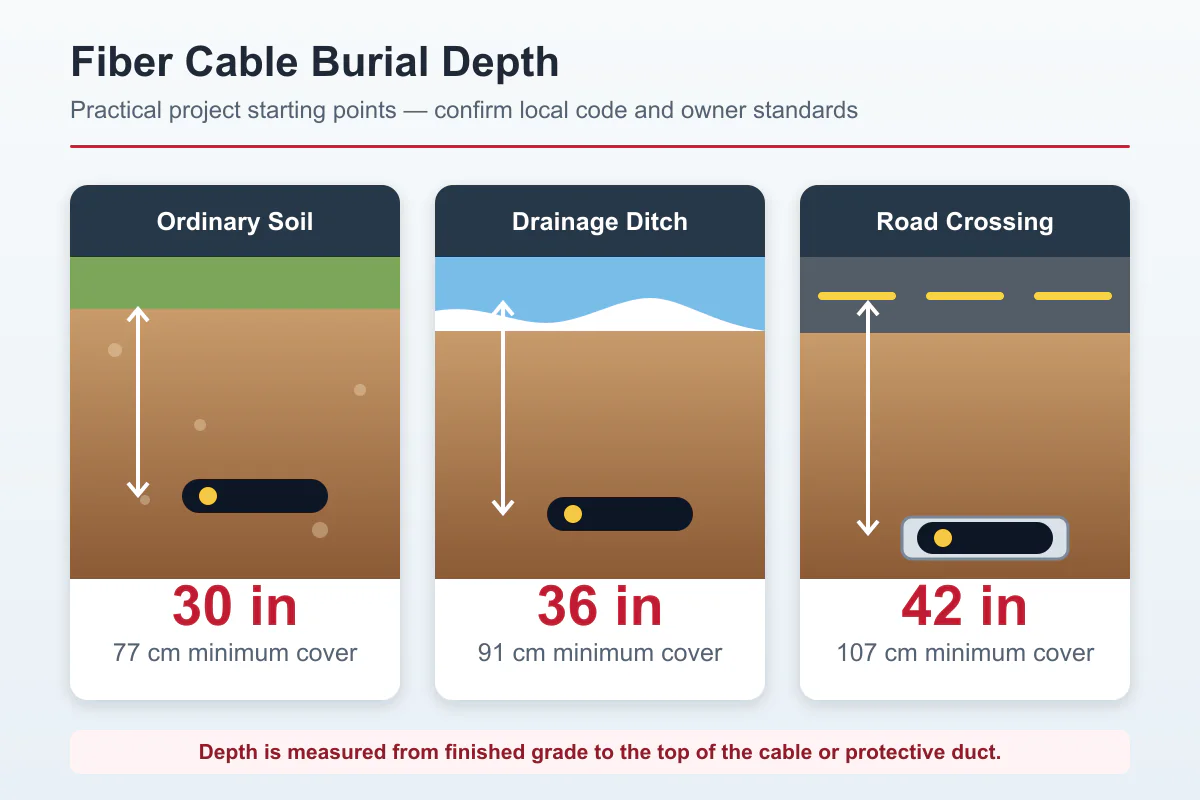
The practical answer is about 30 inches (77 cm) of cover in ordinary soil, with greater depth at drainage ditches and road crossings. However, this is a planning reference—not a universal legal minimum. Local code, the network owner’s specification, final ground level, frost, erosion and traffic loading can all change the required depth.
Burial depth must be confirmed from local codes, the network owner’s specification, final ground level, and approved construction drawings. The values below are planning references only, not universal legal minimums:
| Route condition | Practical reference |
|---|---|
| Ordinary soil | 30 in / 77 cm |
| Under drainage ditches | 36 in / 91 cm |
| Rock | 30 in / 77 cm |
| Road crossing | 42 in / 107 cm |
Depth is normally measured from the finished surface to the top of the cable or protective duct. Always confirm the approved construction drawing before excavation.
Why Burial Depth Changes Along the Route
The same cable route may need several depths.
Normal soil: 30 inches is a useful starting point for a main outside-plant route. It keeps the cable below routine landscaping and shallow maintenance work.
Roads and driveways: vehicle loading and future road work increase the risk. A deeper bore or protective duct is normally considered, subject to the approved civil design and local requirements.
Drainage ditches: erosion can remove soil above the cable. Measure cover from the lowest expected ditch profile, not from the bank.
Rocky ground: if the design depth cannot be reached, do not simply leave the cable shallow. The project may require duct, concrete protection, steel plates or a revised route approved by the engineer.
Direct Burial Cable or Cable in Duct?
These are different purchasing decisions.
A direct-burial cable is designed for installation in the ground without a continuous protective conduit. The construction must be selected for the expected moisture, crush, tensile and environmental conditions. ITU-T L.101 covers performance considerations for optical fiber cables used in directly buried applications.
A duct installation puts the cable inside HDPE, PVC or another approved pathway. It can make replacement and future capacity expansion easier, but the duct route, bends, joints, water management and pulling method still require planning.
Do not assume that every black outdoor cable—or every armored cable—is approved for direct burial. Check the exact datasheet and installation method. Our guide to indoor versus outdoor fiber optic cable explains why the jacket and environment matter.
Six Checks Before Opening the Trench
- Confirm the governing requirement. Check local regulations, the utility owner’s standard and the approved project drawing.
- Locate existing utilities. Never excavate from an old drawing alone. In the United States, OSHA requires the estimated location of underground installations to be determined before excavation and utility owners to be contacted.
- Review the complete route. Mark roads, ditches, culverts, slopes, walls, foundations and future grading areas.
- Choose the cable and protection together. Specify direct burial or duct installation, armor requirement, fiber count, drum length and splice locations as one system.
- Plan identification. Include warning tape, route markers, tracer wire or another approved locating method where required.
- Record the finished installation. Keep as-built depth, route coordinates, handhole positions and cable drum records for later maintenance.
For short subscriber routes, requirements may differ from a backbone route. If the project is evaluating last-mile constructions, see our FTTH drop cable selection guide.
What Should Be Included in the Cable RFQ?
When a buyer asks us for a “buried fiber cable,” the first question should not be fiber count. It should be the route.
Send the supplier:
- installation method: direct burial, duct or mixed route;
- total route length and required drum lengths;
- fiber count and fiber type;
- soil, rock, drainage and road-crossing conditions;
- required armor or non-metallic construction;
- expected pulling or blowing method;
- applicable cable standard and project-specific test requirements;
- delivery country and project schedule.
This information helps avoid buying an outdoor cable that is not suitable for the actual installation. If trenching becomes impractical, an aerial route may also be worth comparing; our ADSS versus Figure-8 cable guide covers that decision.
Quick Questions
Can fiber optic cable be buried only 12 inches deep?
Only when the local authority and network owner permit it and the design provides suitable protection. A shallow route has greater exposure to landscaping, erosion and future excavation.
Does armored cable automatically mean direct burial?
No. Armor is one part of cable construction. Direct-burial suitability must be confirmed from the exact product specification.
Is the depth different because fiber does not carry electricity?
The optical signal does not determine excavation protection. Burial depth is mainly a civil-engineering decision based on surface use, mechanical risk, soil, erosion and local rules.
Need Help Preparing a Buried Cable RFQ?
Send NetLast your route length, fiber count, installation method, soil and crossing conditions, required standard and delivery country. We can review the cable configuration and related passive materials for quotation.
Burial depth is only one part of route protection. Use our rodent-resistant fiber optic cable selection guide to compare steel tape, FRP/GRP and glass-yarn designs.