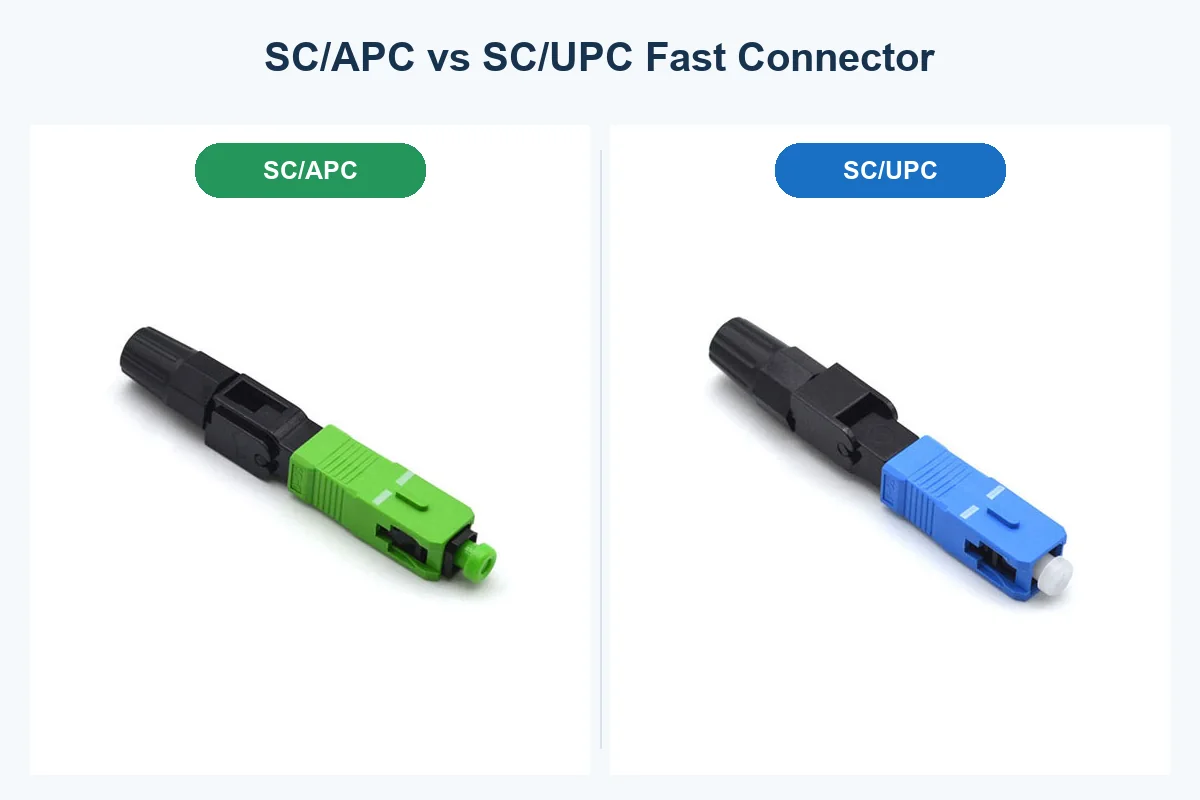
Choose an SC/APC fast connector when the adapter and equipment port are APC, or when the link requires tighter control of back reflection. Choose SC/UPC when the existing interface is UPC. The most important rule is simple: match the polish across the connection and never mate SC/APC directly with SC/UPC.
The green and blue housings make the options easy to recognize, but colour should be a first check rather than the only specification used for purchasing.
SC/APC vs SC/UPC fast connector at a glance
| Check | SC/APC fast connector | SC/UPC fast connector |
|---|---|---|
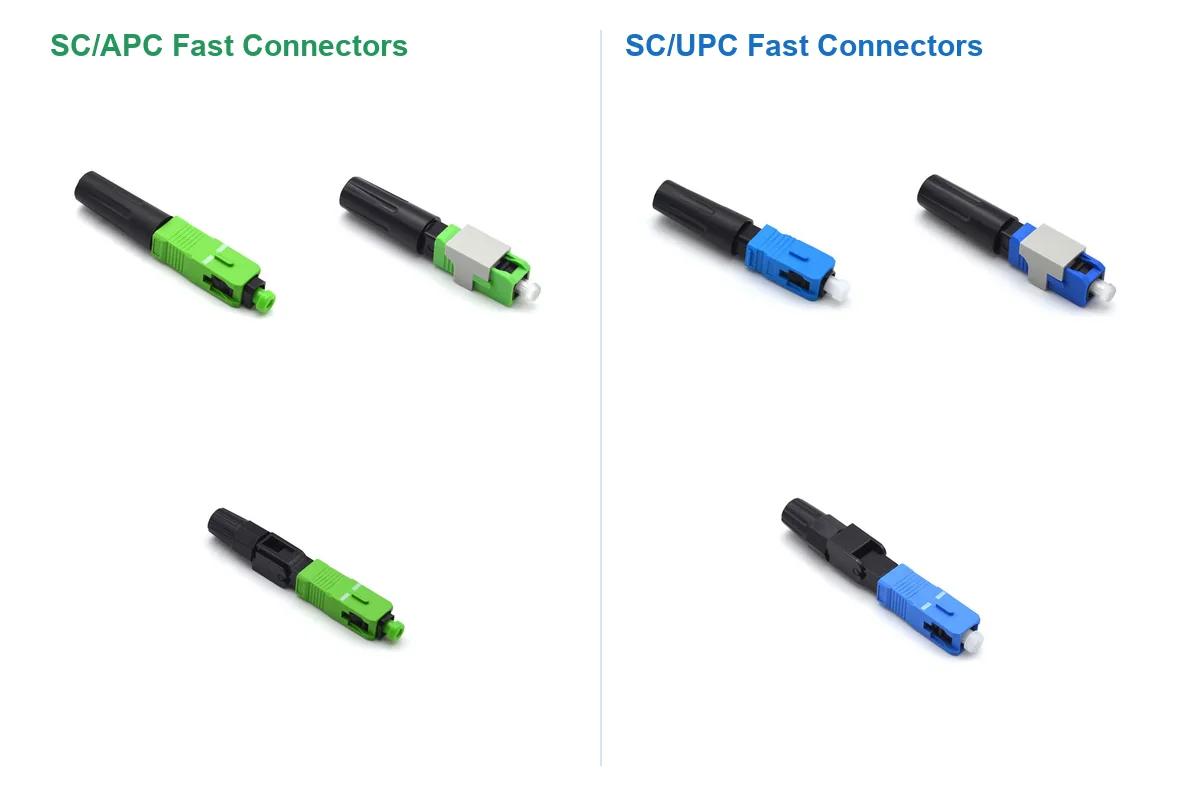
| End-face geometry | Angled physical contact | Ultra physical contact |
| Common housing colour | Green | Blue |
| Main optical advantage | Lower back reflection | Suitable when the network uses UPC interfaces |
| Mating requirement | SC/APC adapter or port | SC/UPC adapter or port |
| Buyer’s first question | Does the link require APC? | Is the installed equipment UPC? |
APC uses an angled ferrule end face to direct reflected light away from the fiber core. UPC uses a refined physical-contact finish without that angle. This is primarily a reflectance decision; an APC label does not automatically mean lower insertion loss than every UPC product. Connector design, cleave quality, cleanliness and installation accuracy still affect the finished link.
Which one is usually chosen for FTTH?
SC/APC is common in many FTTH and PON networks because optical reflections can matter in access links. However, the correct choice is not simply “APC for every FTTH project.” The connector must match the adapter, splitter, distribution box and ONT or other equipment already specified.
Use SC/UPC when the installed network and equipment are built around UPC interfaces. Converting only one point to APC creates a mismatch rather than an upgrade.
If you are replacing an existing connector, check both the housing colour and the marking on the adapter or equipment. When documentation and port colour disagree, confirm the equipment specification before ordering. For a broader explanation of connector polishes, see our guide to SC/APC and SC/UPC connectors.
Why SC/APC and SC/UPC should not be mixed
APC and UPC ferrules meet at different geometries. Mating them can prevent correct physical contact, increase loss and reflectance, and may damage the connector end faces. An adapter can physically accept both SC housings, but that does not make the optical polishes compatible.
For a field repair, trace the whole connection path rather than copying the connector found at only one end. The fast connector, adapter and mating connector must belong to the same polish system.
Does polish change the installation process?
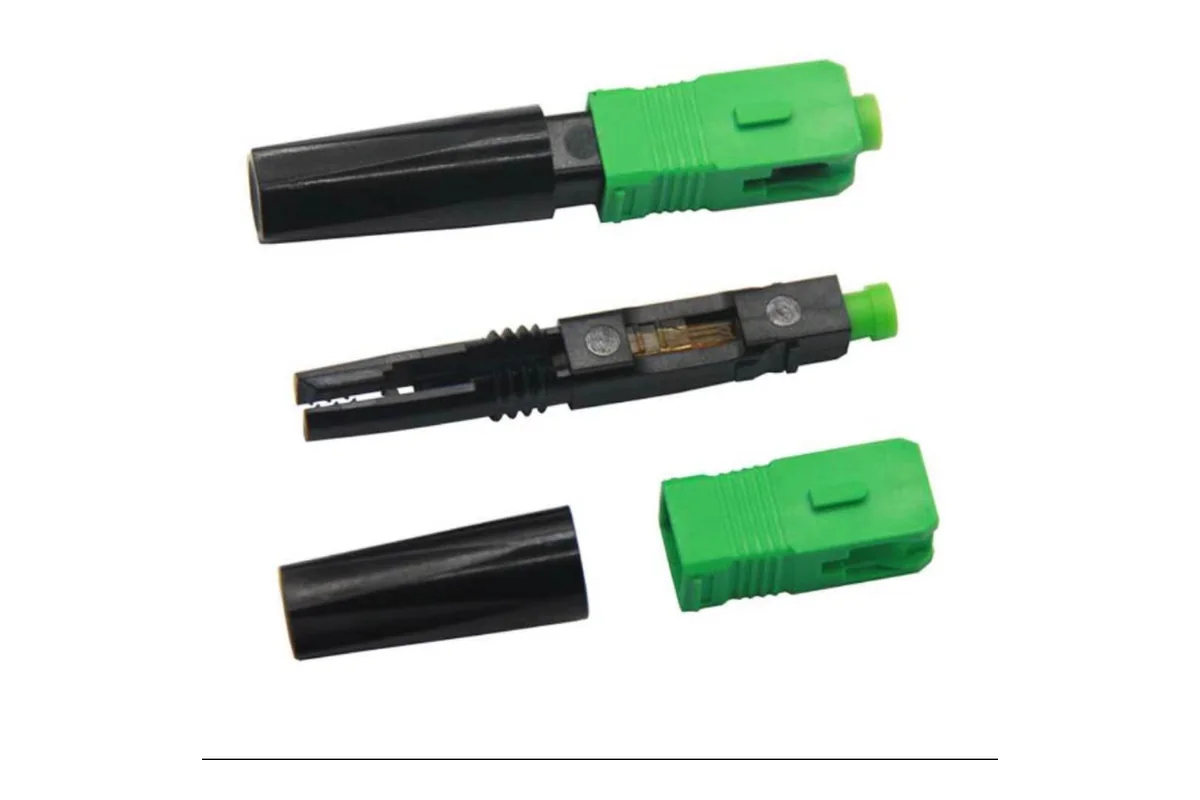
The field procedure is broadly similar: strip the cable, clean the fiber, cleave it to the required length, insert it fully, lock the connector and test the result. The exact dimensions and steps depend on the fast-connector model.
Polish choice does not correct a poor termination. A contaminated fiber, incorrect cleave length or incomplete insertion can cause unacceptable loss with either APC or UPC. Technicians should use the connector’s installation guide and verify the completed link with suitable test equipment. Our fast-connector installation checklist covers the most common field checks.
Five details buyers should confirm
Before requesting a quotation, send the supplier:
- SC/APC or SC/UPC interface required by the network.
- Drop-cable type and exact cable dimensions.
- Fiber type and coating or buffer size.
- Required insertion-loss and return-loss test criteria.
- Quantity, packaging, destination and any installation-tool requirement.
Do not choose by green or blue housing alone. Ask for the exact model specification and, for project orders, confirm a sample against the real cable and adapter before volume production.
NetLast’s 60 mm SC/APC field-assembly connector is one available configuration. Related SC/APC and SC/UPC project options can be discussed, but the selected model must be checked against the actual drop cable and interface. Buyers new to this product can also read what a fiber optic fast connector is and where it is used.
A practical recommendation
If the project drawing already specifies APC or UPC, follow it consistently. If the network is still being designed, decide based on the equipment interface and reflectance requirement, then standardize the same polish at every mating point. This is more reliable than mixing connector types during installation.
For a quotation, send NetLast a photo of the equipment port or adapter, the cable cross-section and dimensions, the required polish, quantity and delivery country. We can review the requested configuration before production.
Frequently asked questions
Is SC/APC always better than SC/UPC?
No. SC/APC offers lower back reflection, but the correct connector is the one that matches the network design and equipment. A mismatched APC connector is worse than a correctly specified UPC connection.
Can a green SC/APC connector plug into a blue SC/UPC adapter?
The SC housing may fit physically, but the end-face geometries are incompatible and should not be mated.
Does APC always have lower insertion loss?
Not automatically. APC mainly improves reflectance performance. Finished insertion loss also depends on connector design, fiber preparation, cleanliness and installation quality.
Need help matching a fast connector to your FTTH cable?
Send NetLast the required SC/APC or SC/UPC interface, cable construction and dimensions, quantity, packaging request and destination. We can review the configuration before quotation.