A fiber optic patch cord and a fiber pigtail can use the same fiber and connector family, but they perform different jobs. A patch cord has a connectorized end at both ends and is used to connect two ports. A pigtail has one connectorized end and one unterminated end that is spliced to an installed fiber.
That one-end-versus-two-end distinction changes the installation method, test plan, enclosure requirements and bill of materials. If two existing ports must be connected, order a patch cord. If a field cable must be terminated inside an ODF, patch panel, terminal box or splice enclosure, the project will normally require a pigtail plus a splice and splice-protection system.
Fiber patch cord vs pigtail: quick comparison
| Selection point | Fiber optic patch cord | Fiber optic pigtail |
|---|---|---|
| Connectorized ends | Two | One |
| Other end | A second connector | Unterminated fiber for splicing |
| Main installation | Plug into two compatible ports or adapters | Splice to the installed cable, then plug the connectorized end into an adapter or port |
| Typical role | Equipment-to-panel, panel-to-panel or device interconnection | Permanent termination of a distribution or feeder cable inside protected hardware |
| Reconfiguration | Can usually be unplugged and rerouted | Spliced end is intended to remain in the termination system |
| Field work | Routing, mating, inspection and testing | Fiber preparation, splicing, splice protection, routing and testing |
| BOM impact | Cord, adapters or ports, labels and cable management | Pigtail, adapter, splice sleeve, tray or holder, enclosure space and splicing work |
| Testing | The complete two-ended assembly can be factory tested | The connector can be tested before shipment; the installed path must also be checked after splicing |
The table describes the product form, not a universal specification. Connector type, polish, fiber type, cable construction, length, test limits and packaging still need to be stated in the RFQ.
What is a fiber optic patch cord?
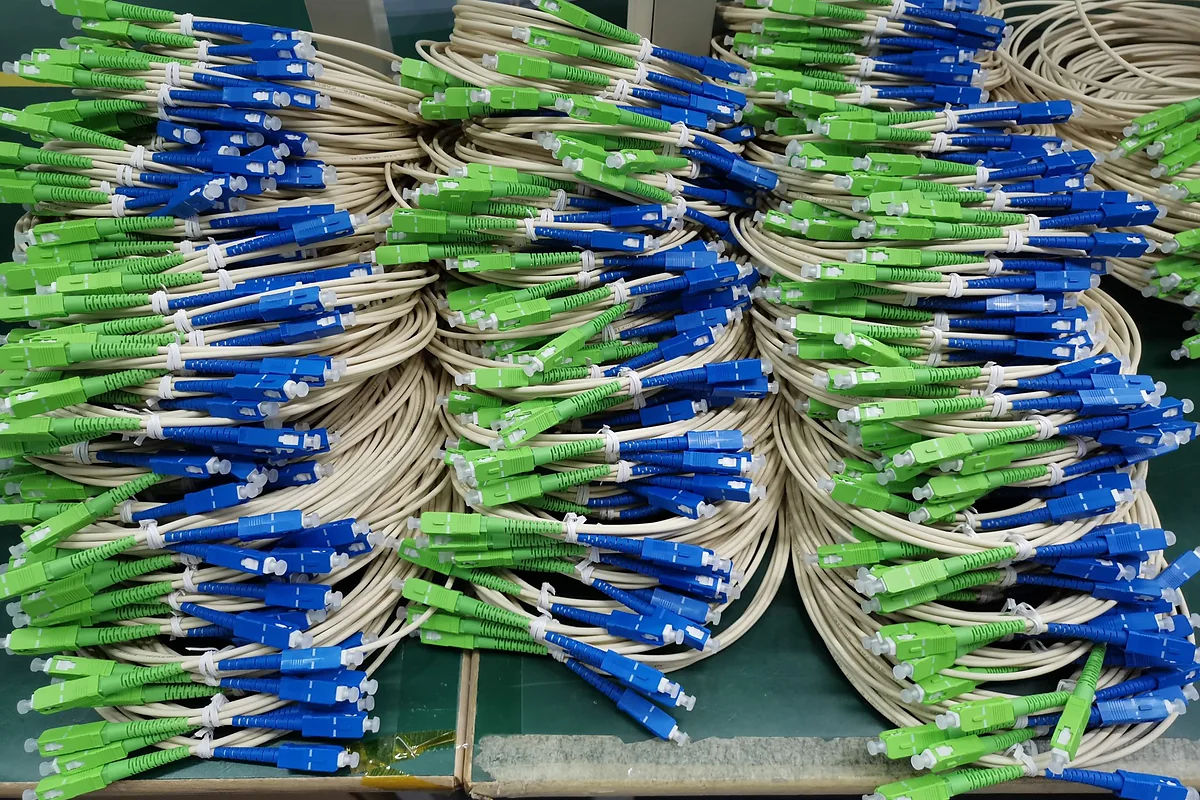
A fiber optic patch cord—also called a fiber jumper or fiber patch cable—is a cable assembly with connectors on both ends. The two ends may use the same connector, such as SC-to-SC or LC-to-LC, or different connectors for a hybrid connection.
Patch cords are useful when both connection points already have compatible optical interfaces. Common examples include connecting active equipment to a patch panel, linking two panels, or connecting a test instrument to a link under test. Because the assembly is handled and rerouted, buyers should confirm the cable construction and jacket required for the actual routing environment.
Two connectors are not enough to make a correct order. The fiber type, connector family, UPC or APC polish, simplex or duplex configuration, polarity where applicable, cable length and test requirement must match the optical system. Connector housing or jacket color can help identification, but color alone is not a reliable purchase specification.
What is a fiber optic pigtail?
A fiber optic pigtail is connectorized on one end and left unterminated on the other end for splicing. The connectorized end creates a controlled interface at an adapter or equipment port, while the splice joins the pigtail to the field cable.
Pigtails are commonly protected inside an ODF, patch panel, terminal box, distribution box or splice enclosure. The installation therefore needs more than the pigtail itself. The buyer or installer may also need adapters, splice sleeves, a splice tray or holder, routing space and a defined fiber-management plan.
“Unterminated” should not be read as “unprotected bare glass supplied without a specified construction.” Pigtails are available in different buffered, jacketed and multi-fiber forms. The exact construction must match the enclosure, splicing method, routing space and project specification.
Where should each one be used?
- Port to port: use a patch cord when both ends plug into existing compatible interfaces.
- Field cable to adapter: use a pigtail when an installed cable fiber must be spliced to create a connectorized termination.
- Field cable to active equipment through a panel: the completed route may use both products—a pigtail inside the panel and a patch cord from the panel adapter to the equipment.
- Pre-connectorized system: confirm the supplied assembly and hardware before adding separate pigtails or patch cords; the termination may already be integrated.
This workflow prevents a common procurement mistake: ordering only the visible connector cable while omitting splice protection, adapters, trays or the patching cord needed to complete the optical path.
Installation and testing are different
A patch cord arrives as a complete two-ended assembly. The supplier can test the assembly before shipment, but installers still need to protect bend limits, route the cord correctly and inspect connector end faces before mating. The receiving inspection should match the purchase specification rather than relying only on a “factory tested” label.
A pigtail is only one part of the finished termination. Its connectorized end can be inspected and tested at the factory, but the splice is created in the field. The installer must prepare the fiber, complete the splice, protect it, route it in the tray and test the completed path according to the project acceptance plan.
IEC 61300-3-35 covers visual inspection of fiber-optic connector end faces and states that visual inspection does not replace optical performance measurements such as attenuation and return loss. Fluke Networks likewise recommends inspecting connector end faces before connection, including new factory-terminated plugs and pigtails.
Can you cut a patch cord in half to make two pigtails?
It is physically possible to cut some patch cords and obtain two connectorized lengths, but that should not be the default procurement method.
The resulting pieces may not match the required pigtail buffer or jacket construction, length, stripping method, labeling, packaging or splice-tray routing. The original end-to-end patch-cord test also does not verify the new field splice or the completed installed channel. Cutting an assembly can additionally complicate traceability and responsibility for the finished termination.
For a controlled project, order purpose-specified pigtails and define the required connector, fiber, construction, length, test documentation and packaging. If an installer proposes converting patch cords, the project owner should approve the method and acceptance criteria first.
Compare installed cost, not unit price
A pigtail may have one connector instead of two, but its installed cost includes splicing labor, splice protection, tray capacity and testing. A patch cord may cost more as a finished assembly, but it can connect two compatible ports without a field splice.
Neither product is automatically the lower-cost choice. Compare the complete compliant system:
- required connectors, adapters and polish;
- pigtail splice materials and enclosure capacity;
- patch-cord routing and cable management;
- installation tools and technician time;
- inspection and optical testing;
- labels, packing and replacement stock;
- project quantity, destination and delivery schedule.
RFQ checklist for patch cords and pigtails
Send the supplier a complete configuration instead of asking only for “SC fiber patch cord price” or “LC pigtail price.” Confirm:
- product form: patch cord or pigtail;
- connector at each terminated end;
- UPC or APC polish;
- single-mode or multimode fiber and exact fiber designation;
- simplex, duplex or multi-fiber configuration;
- cable, buffer and jacket construction;
- finished length and tolerance;
- labels, color identification and packaging;
- inspection and optical test requirements;
- applicable documentation or standards;
- quantity, destination country and requested delivery timing.
If the connector choice is not yet settled, review How to Choose a Fiber Optic Patch Cord. For polish compatibility, see SC/APC vs SC/UPC. NetLast’s current Fiber Optic Cable Assembly category shows available cable-assembly examples; confirm the exact current configuration before treating a listed model as suitable for another project.
Need a patch cord or pigtail quotation?
Send NetLast the connection drawing, connector and polish at every end, fiber type, configuration, cable construction, length, labels, test requirements, quantity and destination. We can review whether the BOM requires patch cords, pigtails or both and identify missing information before quotation.
FAQs
What is the main difference between a fiber patch cord and a pigtail?
A patch cord has connectors at both ends for connecting two ports. A pigtail has one connectorized end and one unterminated end for splicing to another fiber.
Does a fiber pigtail require fusion splicing?
A pigtail is intended to be spliced into the installed fiber system. Fusion splicing is common, but the project design and approved installation method determine the required splice process.
Can a patch cord use different connectors at each end?
Yes. A hybrid patch cord can use different compatible connector types at its two ends. Both interfaces, polish types, fiber type and system requirements must still be confirmed.
Can connector color identify the correct patch cord or pigtail?
Color is a useful visual aid, but it is not a complete specification. Verify the connector, polish, fiber designation, product label and test documentation before installation.
Should patch cords and pigtails have the same test requirements?
Not necessarily. A patch cord is a complete two-ended assembly, while a pigtail becomes part of a completed termination after field splicing. Define factory tests and post-installation acceptance separately.