Choosing an ADSS cable for a Kenyan network project involves more than comparing fibre counts and prices per metre. The right specification must match the route, pole spacing, environmental loads, network capacity, installation method, and compatible hardware.

For an ISP, contractor, distributor, or integrator, the safest procurement approach is to prepare a route-based requirement and ask the cable manufacturer to confirm the complete configuration. This reduces the risk of ordering a cable that looks suitable on a product list but does not match the mechanical or operational demands of the actual installation.
What Is ADSS Cable?
ADSS stands for All-Dielectric Self-Supporting. It is a non-metallic fibre-optic cable designed to support its own weight between poles or other overhead structures without a separate metallic messenger wire.
The active IEEE 1222-2019 standard covers the construction, mechanical, electrical, optical, environmental, installation, and accessory considerations for ADSS cable used primarily on overhead utility facilities. This broad scope is important: an ADSS cable is not defined by fibre count alone. It is part of an engineered aerial cable system.
ADSS can be considered for telecom distribution, broadband backhaul, campus links, and other aerial fibre routes. However, suitability must be confirmed for each route. An all-dielectric construction does not remove the need for electrical-space assessment, pole-owner approval, safe working procedures, or qualified installation personnel.
If the project must also evaluate a ground-wire solution, see the difference between ADSS and OPGW cable before finalising the specification.

Why Price and Fibre Count Are Not Enough
Searches for ADSS cable in Kenya commonly return products promoted by core count, reel length, or price. Those details are useful for an initial shortlist, but they do not answer the most important engineering questions.
Two cables with the same number of fibres may have different mechanical designs, diameters, weights, jackets, tensile limits, recommended hardware, or span capabilities. Their installed cost can also differ once clamps, dead-end assemblies, dampers, joint closures, transport, splicing, and installation labour are included.
Before requesting a quotation, define what the cable must do on the route—not only how many fibres it must contain.
Eight Requirements to Confirm Before Ordering ADSS Cable
1. Route profile and pole ownership
Start with a route survey. Record the total route length, pole locations, pole types, attachment positions, changes in direction, road crossings, unusual long spans, elevation changes, and planned splice points.
Also identify the organisation that owns or controls the support structures. Obtain the required approvals and confirm applicable clearance, safety, and construction requirements before finalising the cable design. A cable supplier can help interpret technical inputs, but route approval and installation safety remain project responsibilities.
2. Actual span conditions
“Span” is not simply a marketing label. Measure the normal and longest pole-to-pole distances and identify exceptional crossings separately. Provide route temperature expectations, wind conditions, installation height, line angles, and any other environmental loading required by the project engineer.
The selected cable must be supported by manufacturer-specific sag and tension information. Use the applicable sag and tension charts for the exact cable construction and avoid cable over-tensioning. Do not substitute a generic online span table for the data supplied for the quoted cable.
3. Fibre count and growth allowance
Select the fibre count from the network design. Consider active links, redundancy, maintenance needs, planned customer growth, future branches, and spare capacity. A lower initial fibre count may reduce the cable purchase price but create expensive capacity constraints later.
Common market listings should not determine the design automatically. Whether the project needs 12, 24, 48, or another fibre count depends on the topology and expansion plan. Confirm the exact NetLast configuration before publication or purchase rather than assuming every count is available with the same mechanical design.
4. Optical fibre specification
State the required fibre standard and optical performance in the request for quotation. The decision should align with the transmission design, equipment, link budget, splicing plan, and compatibility requirements.
Do not accept descriptions such as “single-mode” or “low loss” as a complete specification. Ask for a datasheet that identifies the fibre type, attenuation limits, relevant test methods, and other parameters required by the project. If bend performance or compatibility with an existing network matters, include that requirement explicitly.
5. Cable construction and jacket selection
The cable manufacturer needs enough route information to recommend an appropriate construction. Important inputs can include span, tensile loading, cable diameter and weight limits, moisture exposure, ultraviolet exposure, installation environment, and proximity to electrical infrastructure.
Do not assume that every ADSS jacket or construction is suitable for every pole line. Where the cable will share utility structures, the project engineer and structure owner should define the electrical and installation conditions. The manufacturer should then confirm the proposed cable construction against those conditions.
6. Compatible aerial hardware
ADSS cable and aerial hardware must be treated as a system. The bill of materials may require suspension assemblies, dead-end or tension assemblies, vibration-control devices, down-lead clamps, cable storage, brackets, and closures, depending on the route design.
Hardware selection should match the exact cable diameter, mechanical design, span condition, and attachment arrangement. Generic clamps selected only by appearance or a broad diameter range can create avoidable installation and reliability risks.
Ask the supplier to identify compatible hardware for the offered cable. Ask the installer to confirm quantities from the route survey, including tangent poles, angle poles, terminal poles, and special crossings.
7. Drum length, packaging, and delivery planning
Cable length planning affects both logistics and network construction. Define the preferred drum lengths from the route and splice plan while accounting for installation and termination allowances. Confirm drum identification, end protection, test documentation, shipping dimensions, gross weight, and handling requirements.
For an imported order, compare total landed and installed cost—not only the cable price. Include freight, taxes and duties where applicable, local transport, storage, handling equipment, accessories, splicing, testing, and schedule risk.
Before placing the order, ask NetLast to confirm current production and delivery timing for the exact quantity and specification. Do not plan a rollout around a general lead-time statement.
8. Documentation and quality evidence
A professional quotation should make the proposed configuration auditable. Request the product datasheet, cable cross-section, construction details, dimensional and mechanical data, optical performance, applicable standards, test plan, drum-length tolerances, packaging details, and warranty terms relevant to the order.
For customised cable, agree on the approval process before production. Confirm the cable marking, print legend, drum label, inspection documents, and any required pre-shipment testing. Distributors should also define branding and documentation requirements early to prevent delays.
ADSS Cable RFQ Checklist for Kenyan Buyers
Use the following checklist when requesting a quotation:
| Requirement | Information to provide |
|---|---|
| Project | Network type, buyer role, location, and target schedule |
| Route | Total length, pole type, attachment position, line angles, and crossings |
| Spans | Typical span, longest span, exceptional spans, and route profile |
| Environment | Project-defined temperature, wind, exposure, and electrical conditions |
| Optical design | Fibre count, fibre standard, link requirements, and spare capacity |
| Cable | Required construction, jacket conditions, marking, and drum lengths |
| Hardware | Suspension, dead-end, vibration, down-lead, bracket, and storage needs |
| Closures | Splice locations, closure type, capacity, mounting, and accessories |
| Quality | Datasheets, standards, tests, inspection, and acceptance documents |
| Commercial | Quantity, Incoterm, destination, delivery target, samples, and payment terms |
A complete checklist enables a supplier to quote the right configuration and makes different offers easier to compare on a like-for-like basis.
Evaluate Total Project Value, Not Only Cable Cost
The lowest cable price does not necessarily produce the lowest project cost. A mismatched design can lead to revised hardware, additional splices, installation delays, damaged cable, or replacement work.
Compare suppliers on five points:
- Specification clarity: Does the quotation identify the exact construction and its limits?
- Cable-and-hardware compatibility: Can the supplier provide or confirm a coordinated system?
- Quality evidence: Are datasheets, tests, markings, and inspection requirements clear?
- Delivery planning: Is timing confirmed for the actual configuration and quantity?
- Technical response: Does the supplier resolve questions before production rather than after delivery?
For distributors and integrators, consolidating related fibre cable, hardware, closures, and passive components can also reduce coordination work. The commercial benefit should be evaluated against the verified bill of materials and delivery plan.
Installation and Acceptance Should Be Planned Before Shipment
Procurement is only one part of an ADSS project. Agree on installation and acceptance requirements while the cable is being specified.
The installer should follow the instructions and sag-tension information for the supplied cable. Protect the cable jacket during handling, use compatible stringing equipment and hardware, observe the specified bend limits, and keep records for each installed drum and section. After installation and splicing, complete the optical tests required by the project and retain the results with the as-built route documentation.
Installation near electrical infrastructure introduces serious hazards. Use qualified personnel, approved procedures, and the safety requirements of the relevant structure owner and local authorities. This article is a procurement guide, not a substitute for route engineering or an approved method statement.
Discuss Your ADSS Cable Requirement with NetLast
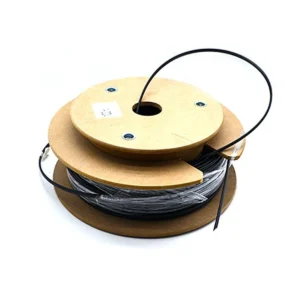
NetLast lists a 12 Core ADSS Fiber Optic Cable and provides fibre-optic manufacturing and OEM/ODM support. The exact cable construction, span capability, fibre specification, jacket, hardware, compliance documents, quantity, and delivery schedule must be confirmed for each project.
Send NetLast your route data, fibre count, required standards, drum plan, hardware list, destination, and target delivery date. The team can review the requirement, identify information that is still missing, and prepare a quotation based on the confirmed configuration.
Planning an aerial fibre project in Kenya? Contact NetLast to request a specification review, product datasheet, sample discussion, and current quotation.
Frequently Asked Questions
What does ADSS mean in fibre-optic cable?
ADSS means All-Dielectric Self-Supporting. It describes a non-metallic fibre-optic cable designed to support itself between overhead structures without a separate metallic messenger wire.
Which ADSS fibre count should an ISP choose?
Choose the fibre count from the network topology, active links, redundancy, maintenance plan, and expected expansion. Do not select 12, 24, or 48 fibres only because that size is commonly advertised. Confirm both optical capacity and mechanical construction.
Can ADSS cable be selected from span distance alone?
No. Span is an important input, but cable selection also depends on route geometry, environmental loading, sag and tension limits, attachment conditions, cable construction, and compatible hardware. Obtain manufacturer-specific engineering data for the proposed cable.
Does ADSS cable require special hardware?
Yes. Suspension, dead-end, vibration-control, down-lead, and other components must be selected for the exact cable and route. Ask for a coordinated cable-and-hardware proposal rather than treating clamps as generic accessories.
What information should a Kenyan buyer send for an ADSS cable quotation?
Send the route length, normal and maximum spans, pole and attachment information, fibre count and standard, project environmental conditions, required drum lengths, hardware and closure needs, quality documents, destination, quantity, and required delivery date.